What is a song battle game?
Two tracks, one choice, no wrong answers — and what separates a bracket from a chart.
A song battle game puts two songs head to head and asks you to pick one. That is the whole mechanic. There is no correct answer and nothing to guess: the game is recording a preference, not marking a test.
On its own, one person picking between two songs is trivia-night small talk. What makes the format interesting is what happens when thousands of people do it. Pairwise choices pool extremely well across strangers, so a large pile of individually trivial votes turns into something a five-star rating system could never produce — a ranking that reflects what people would actually choose, rather than what they happened to stream.
Song battle vs. music trivia
These get shelved together in app stores and they are almost opposites. It is worth being precise, because the two formats attract completely different moods.
Music trivia tests knowledge and has right and wrong answers — naming a track, finishing a lyric, identifying an artist. A song battle tests preference and has neither. Trivia produces a score for the player; a song battle produces a ranking for the songs.
| Music trivia | Song battle | |
|---|---|---|
| Question asked | Do you know this? | Which do you prefer? |
| Right answer | Yes | No |
| Who is measured | You — you get a score | The songs — they get a ranking |
| Feels like | A quiz you can fail | An argument you can't lose |
| Rewards | Recall and breadth | Having taste and using it |
If you want to test what you know, you want a trivia app. If you want to settle what you think, you want a song battle.
Brackets vs. endless head-to-heads
Within song battles there is a real design split, and it decides what the game can produce.
The bracket
A music bracket is a single-elimination tournament — a fixed field of 8, 16 or 32 songs, narrowed round by round until one survives. Brackets are satisfying because they end. You get a champion, a bragging-rights screenshot, and a finished thing to share.
Their weakness is structural: a song knocked out in round one is never compared again. It might have been the second-best track in the field and you would never know, because it drew the eventual winner first. A bracket tells you who won a particular tournament. It cannot tell you how good the songs are relative to each other.
The endless head-to-head
The alternative is to never stop — keep serving matchups, and let every song accumulate a record against many opponents over time. Nothing is eliminated. A song that loses badly on Tuesday can be re-tested on Friday against a different opponent.
This is worse as a party game and far better as a measuring instrument. Because every song keeps getting compared, you can maintain a rating for each one and get a genuine ordering out of it — a chart, rather than a champion.
How the votes become a ranking
Once you have a stream of head-to-head results, you need a way to convert them into an order. The established answer comes from competitive chess: rating systems in the Elo family, of which Glicko is a modern refinement.
The principle is that the quality of your opposition counts. Beating a song that has been beating everything else moves you a long way. Beating a song that loses constantly moves you barely at all. That is what prevents a track from climbing on a diet of easy matchups.
Glicko adds a second number to each rating — a confidence interval — so a song with six votes is visibly less certain than a song with six hundred, and is not allowed to sit at the top of a chart on thin evidence. The full explanation is here, including why most categories deliberately stay unpublished until enough people have voted in them.
Where to play one
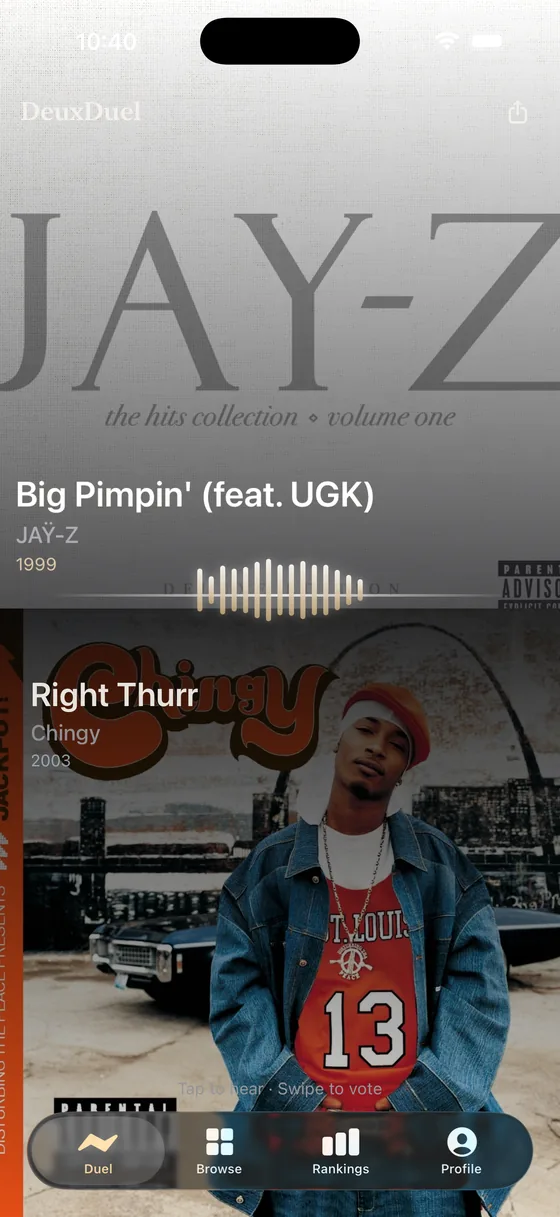
DeuxDuel is a free endless-head-to-head song battle for iPhone. Two tracks, tap to listen, swipe to vote, and every vote moves a global ranking built entirely from listener choices.
- Free — every matchup, category and ranking. An optional subscription removes ads.
- No Apple Music subscription needed — it plays the 30-second previews available to everyone.
- 143 categories by era, genre and mood — 90s alt-rock, hip-hop classics, 2000s pop, country, K-pop, reggaeton and more.
- A Daily Duel and curated Sets if you want a bracket-shaped run with an ending, alongside the endless feed.
- iPhone, iOS 17 or later. No Android version today.
Two songs enter. You decide.
Download DeuxDuel free